
NEWS
Hockey 4 Youth in the News
Quebec Hockey Hazing Inquiry (CBC News Network Live)
Hillary Johnstone (CBC):
We've reached Moezine Hasham. He's the founder and executive director of the Hockey 4 Youth Foundation. It fosters inclusion for newcomers of all genders in hockey with programs in both Ontario and Quebec. Moezine also played minor and university hockey. Thank you so much for coming to join us in speaking about all of this today.
Moezine Hasham:
Thanks for having me, Hillary.
Hillary Johnstone (CBC):
We've reached Moezine Hasham. He's the founder and executive director of the Hockey 4 Youth Foundation. It fosters inclusion for newcomers of all genders in hockey with programs in both Ontario and Quebec. Moezine also played minor and university hockey. Thank you so much for coming to join us in speaking about all of this today.
Moezine Hasham:
Thanks for having me, Hillary.
Hillary Johnstone (CBC):
So, Moezine, what does it indicate to you that these hearings were even called in the first place?
Moezine Hasham:
Yeah, look, I think it's an important topic. I think it definitely needs to be studied. But as we've seen over the past several months, including with Hockey Canada, there's a toxic culture that permeates minor hockey, specifically when it comes to boys and young teens. And that's a challenge for the game in and of itself.
But also it's a challenge for us, working in the sport development community, to focus on what's really the important part of playing a sport like hockey. That idea of having fun, teamwork, and building friendships, all of those things are being overshadowed by these stories that continue to come out. And it's a big problem when it comes to even getting newcomer kids or kids who are not born in Canada into the game of hockey. There are some serious issues here around sexual assault, and it goes on from there.
There are problems with misogyny and homophobia, transphobia. All of these issues permeate these closed cultural environments of hockey inside arenas. And while it's being studied, and the Quebec government should be commended for that, the issue has been here for decades, and I'm really focused on looking at what are the concrete solutions coming out of this situation and when are we going to help these young men to heal, when are we going to help the victims heal?
This is a problem for hockey right across the country. I can tell you that this is probably a situation that's going to showcase itself in other parts of the country as more people come forward.
Hillary Johnstone (CBC):
And as someone who works with youth Moezine, what do you hope that some of those solutions that you're talking about, what do you hope some of those solutions might be?
Moezine Hasham:
Yeah, well, look, I know the Quebec government a while back had talked about forming a committee to talk about why people aren't kids, in particular, aren't joining hockey. And I can tell you, I wasn't invited to those meetings. I speak French fluently. I was born and raised in Vancouver to parents who were refugees to Canada.
I've played hockey my whole life. Every time I have a platform, I talk about the inclusion side of hockey. What we've done here at Hockey 4 Youth Foundation is create a safe, inclusive environment where we're welcoming kids of all genders. We're welcoming teens representing 38 countries of origin, Canadian kids who are born here from low socioeconomic backgrounds.
To get into the game, there needs to be more investment in the type of hockey that we're delivering, because we're seeing the problems that are occurring at the provincial sport organization level, the national sporting body that governs hockey. They have a lot of issues that they can't resolve, and that's a problem. But on the flip side, organizations like mine, there are organizations like Black Girl Hockey Club; we're doing the work on the ground to really make the game a safe, inclusive space.
Because at the end of the day, Canada thrives on hockey. We forget about how much we love this game, but every time these stories come out about racism, misogyny, sexual assault, and toxic culture, it's damaging to the game. And so for us at Hockey 4 Youth Foundation, we're soon going to be in Calgary, Edmonton, and Vancouver, which makes us a national charitable organization that's going to help foster the positive side of the game. So I hope that governments reach out to me and my organization to ask us how can we help them to deliver more safe and inclusive hockey experiences to families and kids as you say.
Hillary Johnstone (CBC):
Moezine, likely some of these issues that are being discussed right now have been going on for years. But now that they really are sort of out in the open and that there is a spotlight on them, what sort of questions are you getting from both kids and parents when it comes to whether or not they're going to be safe playing these sports?
Moezine Hasham:
Yeah, look, our organization, we're not a minor hockey organization. And frankly, I've got friends and family that have put their kids into hockey. Generally speaking for myself, I had a very safe experience in minor hockey. So maybe I was one of the lucky ones and maybe there are other kids who didn't have that experience.
But the kids who are facing these experiences of hazing and toxic culture, that is problematic because as they grow out of hockey, how are they going to be in society? I always say that what happens inside the arena doors is problematic when you go outside of the arena doors and parents and families and kids aren't able to interact in the way that they should.
And so what I'm really looking for here right now is what are the concrete solutions? What are we doing to fix the culture of silence? What are we doing to fix the game itself? It's really a difficult situation that's occurring, whether it's at the Hockey Canada level, whether it's in the QMJHL, whether it's in minor hockey again, the focus and emphasis on young boys and men who are in these environments where they are taught a culture of silence, and that's problematic from my perspective.
We need to do more investing in the fun side of the game. Not everything needs to be about winning this trophy and that tournament. It's got to be about grassroots, fun hockey that's safe, inclusive, and welcoming to all. That's the way you create a game. That's what I grew up playing and that's what I want to see happen coming out of this.
I want to see the Quebec government invest in organizations like ours that are doing the legwork. We were just in Montreal two weeks ago launching a program with the NHL Player Inclusion Coalition and Georges Laraque for 28 girls who had not played hockey before. So there are ways to make this game accessible and fun and inclusive and safe. We need to do a better job of doing that.
Hillary Johnstone (CBC):
Well, let's hope more of that starts to happen, Moezine. Thank you so much for this. We really do appreciate your time today.
Moezine Hasham:
Thank you, Hillary. Really appreciate it.
Hillary Johnstone (CBC):
Moezine Hasham in Toronto. He's the founder and director of Hockey 4 Youth.

That First Step (The Hockey News)
From securing corporate sponsorships to tying hundred of skates, Hasham sees his labor of love come to fruition every time a kid steps on the ice for the first time. BY JARED CLINTON
There came a point when Moezine Hasham began to lose count of how many pairs of skates he had tied, It could have been when the number eclipsed a couple dozen. More likely, it was when it reached into the hundreds.
It should be said, though, that this failure of memory is a point of pride for Hasham. He'd have it no other way. As founder and executive director of Hockey 4 Youth, pulling tight the laces on a first-timer's first pair of skates is his opportunity to share a special and personal moment with those he has sought to reach through his charitable venture: Canadian youth, particularly newcomers, who want to learn about and experience the national pastime in a safe environment.

From securing corporate sponsorships to tying hundred of skates, Hasham sees his labor of love come to fruition every time a kid steps on the ice for the first time. BY JARED CLINTON
There came a point when Moezine Hasham began to lose count of how many pairs of skates he had tied. It could have been when the number eclipsed a couple dozen. More likely, it was when it reached into the hundreds.
It should be said, though, that this failure of memory is a point of pride for Hasham. He’d have it no other way. As founder and executive director of Hockey 4 Youth, pulling tight the laces on a first-timer's first pair of skates is his opportunity to share a special and personal moment with those he has sought to reach through his charitable venture: Canadian youth, particularly newcomers, who want to learn about and experience the national pastime in a safe environment.
“I use it as an opportunity to get to know the kids,” Hasham said. “I like learning their story, where they're from, what their ambitions are in life, because we’re more than hockey. We’re dealing with teenagers who are, in a lot of cases, new to the country. But even the ones who have grown up here, they've never had access to the sport, never had an opportunity to play, so anytime I'm able to spend time with them, be it on the ice, tying skates, helping with equipment, that, to me, is my happy place.”
And it’s a happy place Hasham has fostered over countless hours, turning his labor of love into a full-time venture to which he has dedicated nearly every waking moment since beginning this deeply meaningful journey in 2015.
To understand what Hockey 4 Youth means to Hasham, it’s important to understand his story and two snapshots in particular, which planted the seeds for the charity’s formation.
The first is Hasham’s own introduction to the game, which came first through street hockey and later led to the ice through the actions of a neighbor who not only encouraged Hasham’s parents to enroll him in the sport but provided him with equipment her son had outgrown. That moment of charity from his neighbor, who he respectfully and deferentially refers to as “Mrs. Brown,” led Hasham to witness first-hand the diversity, and at times the lack thereof, that can exist within the sport. It also allowed him to begin forging his lifelong passion for the game.
But as important, and perhaps more so, was a yearlong sabbatical in 2013, during which Hasham travelled the world, stopping for six months to spend time in Uganda with his ailing father. It was during this time that Hasham, whose parents were exiled from Uganda as a result of the since-deposed dictator Idi Amin's ordered expulsion of South Asians in 1972, learned of the way in which the upheaval dashed his father's own career dreams. It was then that Hasham resolved to pursue his own passions. And so, after finishing contract work with the Pan American Games in 2015 following years spent in corporate philanthropy. Hockey 4 Youth was born.
“I had no backup plan,” he said. “I knew could go back into the corporate sector or private sector because by this time I was well-seasoned in community relations and corporate philanthropy and all that. If I needed to jump back in, I would, but didn't want to. I really, really wanted this to work.”
For Hasham, that meant weathering some lean years during which almost every cent was funnelled back into Hockey 4 Youth. Making ends meet during those times was a matter of leaning on his support system, not the least of which was his “rock,” then-girlfriend and now wife, Monika, who sits on the Hockey 4 Youth board. But despite the challenges, the charity has had a steady, if at times inconsistent, progression.
In its first year, Hockey 4 Youth had one pilot program. By 2017, with two programs in operation, the organization received its first major grant, from the Toronto Maple Leafs. Combined with the exposure and backing that came along with it, that led to a third program. Since then, Hockey 4 Youth has experienced something of a boom, more than doubling in size over the past several years despite the challenges in both on-ice activity and fundraising presented by the COVID-19 pandemic.
One of the factors most aiding in Hockey 4 Youth's growth is its clear vision and commitment to creating access to the game. To wit, beyond his own history with the sport as a first-generation Canadian, Hasham is driven to bring the game to Canadian newcomers, spurred by the result of a 2014 report from the Institute for Canadian Citizenship. The report indicated that while 71 percent of new citizens expressed an interest in hockey, a mere one percent actually participated. Couple that with the financial impediments and Hasham saw an opportunity to close the gap.
“If you're a 16-year-old girl and you've just arrived here from Syria, and even if your parents have money, it’s not like you can just sign up and start playing hockey,” Hasham said. “The minor-hockey system is not designed like that. And that's not a knock. That's just the way it is. So, for us, can we create a safe, inclusive environment for these kids? Can we give them an opportunity to develop friendships the way we did when we were growing up playing hockey or other sports?”
Hockey 4 Youth strives to create that environment by removing the barriers, including securing ice time, equipment and transportation to and from the rink. The sessions often take place after school and include supervision from teachers and volunteer coaches. There's also off-ice experiential learning that elevates the program beyond its on-ice element. The latter is called the TEACH program, which stands for Technology, Entrepreneurship, Arts, Community Giving and Healthy Active Living.
“A lot of times what happens with kids, especially low-income kids, is they don't have access,” Hasham said. “They might not even be leaving their community. Taking them out of the community, taking them to a hockey game, taking them down to Bay St. and doing financial-literacy training, it opens their eyes to what else is out there.”
All of this, of course, is made possible through donations and partnerships. Beyond their initial grant in 2017, the Leafs partnered with the Buffalo Sabres and the NHL to begin a legacy project in Hamilton in commemoration of the 2022 Heritage Classic. After its launch in October 2022, the project became the 11th Hockey 4 Youth program, adding to recent programs in Ottawa and Montreal, the latter of which was aided by funding from the Canadiens. Other partners have included Canadian Tire’s Jumpstart, Bauer, the Ontario Trillium Foundation and Scotiabank.
Securing financial support, Hasham said, is the hard part. But the work is worth it through the impact the program is having and legacy it's creating. By his most recent count, more than 550 kids have come through the program and more than 36 countries of origin are represented, including Syria, Ukraine, Afghanistan, Vietnam, Philippines, Somalia and Ethiopia. And no matter how long the hours or how difficult the fundraising, it’s all worth it for Hasham after those skates are tied.
“What I love about our program and when you do a launch event is getting these kids on the ice and seeing that first step,” he said. “That first step is the same for them as it was for me, as it was for anyone who’s playing professional women’s hockey or professional men’s hockey. We all had that first step, and it doesn't change. It doesn't matter where you’re from. That first step is the first step.”
From The Rookie Edition of The Hockey News: Published February 2023
Top 20 Change-Makers: Moezine Hasham (The Hockey News)
From The Hockey News’ 2023 Money & Power Edition:
‘Agents of Change - Moving Things Forward’ - pg. 74
By Ian Kennedy
The need for social change in hockey has never been more apparent than it has been over the past year. A public reckoning has occurred related to hockey's culture and its associated issues of racism, homophobia, transphobia and sexual violence.
From The Hockey News’ 2023 Money & Power Edition:
‘Agents of Change - Moving Things Forward’ - pg. 74
By Ian Kennedy

The need for social change in hockey has never been more apparent than it has been over the past year. A public reckoning has occurred related to hockey's culture and its associated issues of racism, homophobia, transphobia and sexual violence. The need to create safer spaces - free from abuse and harm - has never been greater. For the past two years, The Hockey News' Money and Power issue has highlighted 20 change-makers in the game. And this year is no different. Social leaders previously highlighted, such as R. Renee Hess, Brock McGillis, Dr. Courtney Szto, Akim Aliu, Sheldon Kennedy and Dr. Cheryl MacDonald, unquestionably continue to create a safer, more inclusive and equitable sport for all. But this list will highlight 20 new names you may not previously have heard. Meet these 20 activists, advocates, allies and organizers who create space, break barriers and spur social change in hockey.
Moezine Hasham - Hockey 4 Youth Founder
Through his organization, which aims "to increase social inclusion for new Canadian and high-priority youth through our free ice hockey and off-ice life skills" programs, Hasham is directly impacting young people. The off-ice programming, known as "T.E.A.C.H.," provides youth access to - and education regarding - technology, entrepreneurship, the arts and community-giving opportunities and also provides the tools to build a healthy, active lifestyle. Hasham has been running the program since 2015, and the powerful impact Hockey 4 Youth is having on teens across Ontario (and now into Quebec) is immeasurable.
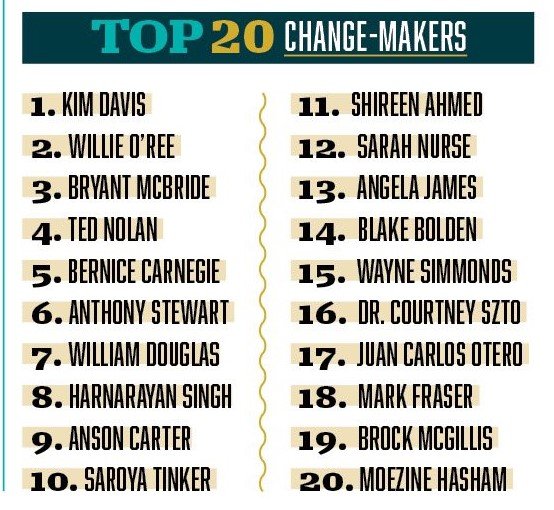
‘Ranking the Change-Makers’ - pg. 76
By W. Graeme Roustan
I recently donated 1,000 Christian hockey sticks and two sets of goalie equipment from my Roustan Hockey company to the Hockey Equality organization run by Chante Eastmond and Anthony Stewart in Scarborough, Ont.
Eastmond and Stewart are leaders not only in the BIPOC community but also in the overall hockey community with their combined efforts to grow the game at the grassroots level. Stewart's career in the NHL is something I envy, as I would have loved to play in the NHL and be able to use that experience in a way that he has to lift others to believe in themselves and to pursue their dreams.
Inspired by Eastmond and Stewart, I donated sticks and gear to Hockey Equality, and it made me think that I would ask some social-change leaders who they believed were making a lasting impact on what was important to them. The criteria was framed up with some general guidelines, which were: 1) impact of their work over a sustained period of time; 2) impact across national scale and reach; 3) proven ability to create authentic and systemic change; 4) measurability of work; and, 5) proven community builder.
There is nothing scientific about the compilation of this list, as it is only the thoughts and perceptions of 17 respondents, all of whom are working for social change in their communities. They were each asked to provide a list of people who met the criteria as they discerned that to be in numerical order of importance, with No. 1 being the top performer.
All 17 submitted their individual lists, which contained between seven and 25 names. They were not restricted from placing their own name on their lists, and some did. However, when they did include their own name, we averaged the result across the entire field of 17 respondents.
Our tabulation system gave sequentially higher points to individuals within the top five- 35 voting points for 1st, 30 for 2nd, 26 for 3rd, 23 for 4th, 21 for 5th, 20 for 6th, all the way down to two points for 25th.
Carnegie Initiative shines light on programs attempting to make hockey more inclusive (Yahoo! Sports)

He says his program has worked with over 600 kids representing 38 different countries and that 71 percent of newcomers express a desire to play hockey, but only one percent actually have the means to do so. MORE >